The makerspace doesn’t have many smart home / commercial IoT devices at the moment, but I want to potentially have a POE tablet in each room to control audio, have a button for emergency calls, maybe the ability to report broken equipment. Later we can add some temp controls, monitoring, and lights as well. I’m wondering if it’s worth experimenting with a Home Assistant server on a modern Pi. Anyone have any recent experience with Home Assistant? Does this sound interesting to anyone to help get set up?
I literally just set it up for my apartment. I did it via using a container, not the OS version. Even so it was still fairly straightforward to set up. If you don’t have a pi I have one that I could part with.
1 Like
Thanks @paul ! What are you controlling in your apartment? How hard is it to build interfaces for people to control things?
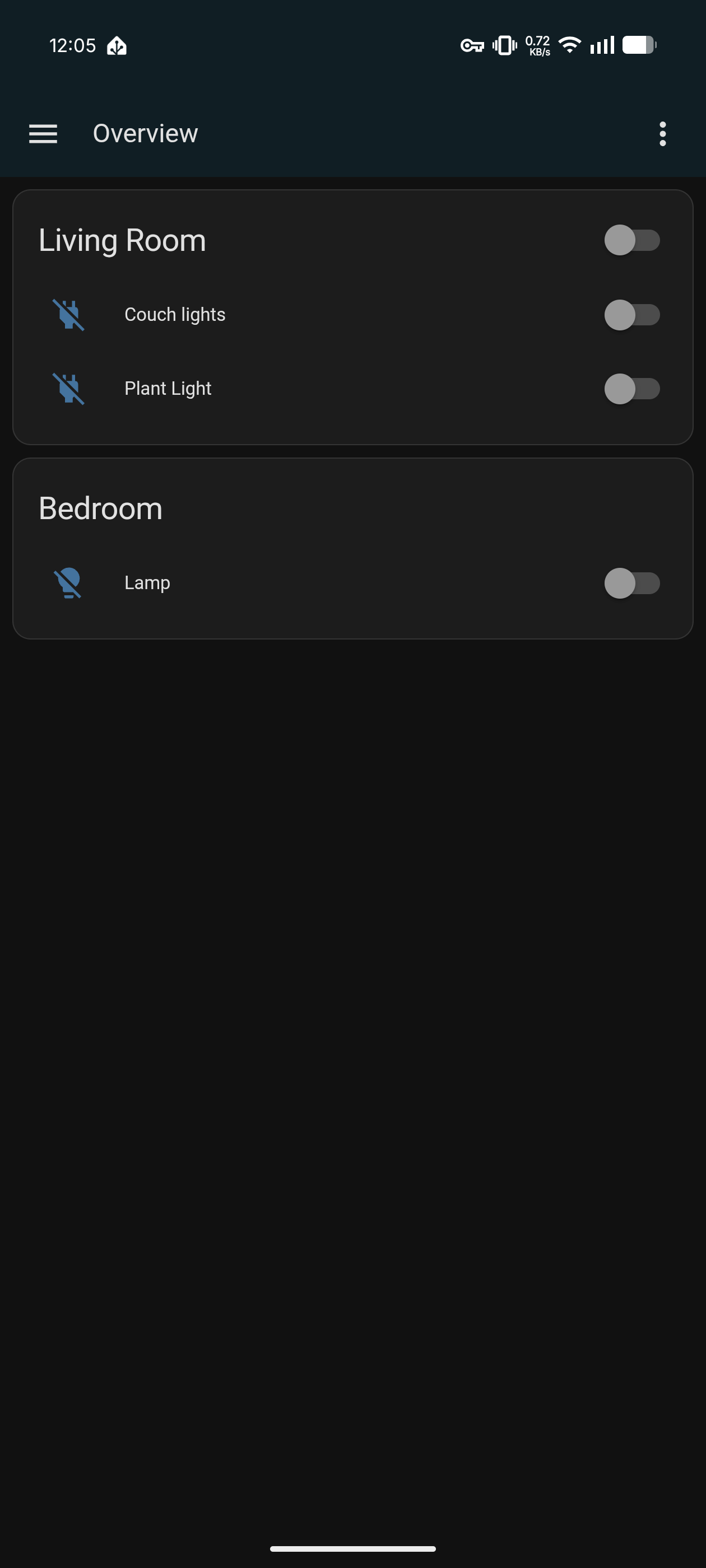
My setup is fairly simple. I only have 2 Smart switchs and a smart light bulb. I’m thinking of adding a third switch for my 3D Printer.
Home Assistant does have a dashboard screen available from the app or included webserver. For simple stuff it’s very easy to set up dashboards. Just look at the demo on there site Dashboards - Home Assistant . More or less drag and drop but you can make it as complicated as you want. (The joys of open source).
I believe you can have multiple accounts for access control, but I have not played around with them. Also, since I only have two zones the dashboard is very bland. The makerspace would have a lot more zones and could have a lot more items.
I only use my phone to control it via a quick settings tile and I’m still working on getting automations to work. Those seem to be a bit more complex. But they could definitely support help/attention needed buttons/toggles and notifications.
Nice! I just got a Wiim amp for the space today, so that maybe we get some more in the future to tie across the space. I’m wondering how well we can integrate that in to a server to control automatically reconnecting zones to a stream if the bluetooth is disconnected, etc.
Let’s see if we can get a few other people that want to jam on this, and maybe next month we try and get something running.
If you get a chance, can you do a little digging to find small tablets or 1 gang screens we could maybe buy/install in the studios to control things?
I don’t know anything about home assistant, but it would be nice to firewall all of the IoT devices on their own isolated network, and only let them communicate with the outside world when doing maintenance. (Or ideally, never…) I’m looking for little networking projects to help me learn, I’d be happy to help set this up or other similar things if that’s helpful!
I found these (a couple of months ago). HA integration was pending but is now supported via plugins.
@mzocher Is the rpi still kicking or has that been taken down for now?
The main things I would want to think through early are network separation, account permissions, backups, and what happens when the server or network is unavailable. A Pi would be perfectly reasonable for testing, although if this grows into something operational for the whole space, I would eventually lean toward a small dedicated mini PC with a supported backup and recovery plan.
I also think the broken-equipment reporting idea could be especially useful. A room screen could have a few large buttons that create a notification or submit a short form with the room and equipment already identified.
I would be happy to join a working session and help map out a small pilot.
1 Like
I’d love to join that session!
I could see this becoming more than just a room-control project.
A lot of what I have been working with lately involves AI-assisted documentation, ticket review, alert summarization, troubleshooting guidance, and agent-style workflows. Some of those same ideas could fit well here once the basic Home Assistant setup is working.
A few examples:
- AI equipment assistant: A member could select a machine from the room dashboard and ask questions such as, “Why is the laser cutter not starting?” or “What material settings should I use?” The assistant could answer from approved makerspace documentation, safety procedures, and known fixes instead of pulling random answers from the internet.
- Smarter broken-equipment reporting: Instead of only pressing a “broken” button, the screen could ask a few relevant follow-up questions, collect a photo or short description, identify the room and equipment automatically, and route the report to the right person.
- Automatic issue summaries: If several people report similar symptoms, AI could combine those reports into a useful summary such as, “Three users reported inconsistent extrusion on Printer 2 after the nozzle replacement.” That would make it easier to spot patterns and reduce duplicate work.
- Daily room and equipment health summaries: Home Assistant could collect information such as temperature, humidity, device status, door activity, power usage, and equipment availability. AI could turn that data into a short daily summary instead of sending a stream of individual alerts.
- Better alert filtering: Similar to work I have done around ticket and infrastructure alerts, AI could help separate normal short-term events from issues that need attention. A device briefly disconnecting once would be treated differently from a device dropping offline repeatedly throughout the day.
- Natural-language room setup: A member or instructor could request something like, “Set this room up for a woodworking class,” and the system could prepare the appropriate lighting, audio level, ventilation settings, equipment checklist, and room instructions.
- Knowledge capture: When an experienced member explains how they fixed a problem, AI could turn those notes into a draft troubleshooting article or maintenance procedure for someone to review and approve. That would help preserve knowledge that would otherwise stay with only a few people.
- Usage and planning insights: Over time, AI could summarize which rooms and machines are used most, which equipment has repeated failures, where maintenance time is increasing, and where additional training or replacement equipment may be needed.
I would probably start with the equipment assistant and smarter issue reporting, since those could provide immediate value without putting AI in direct control of anything important.
I would also be interested in getting more involved with this project and helping guide it toward more automation over time. Home Assistant could provide the control and monitoring layer, while AI handles the guidance, classification, summarization, documentation, and routing around it.
– reply crafted with AI